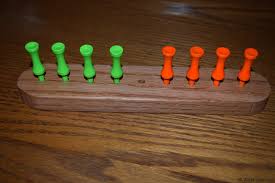
I first got this puzzle in my stocking for Christmas when I was 11 or 12 years old. I solved it pretty quickly, then challenged my family to solve it as well. It kept it and brought it to my classroom when I started teaching. It was in my classroom for over a decade before I discovered there was a pattern that could be expressed algebraically embedded within the solution.
The Scenario
In the Leap Frog Puzzle, the goal is to get the green pegs (frogs) to switch sides with the red pegs (frogs). You can’t just rotate the whole game about the center hole 😀. The frogs can make two kinds of moves: (1)They can scoot to an empty, adjacent hole or (2) they can hop over one frog to an empty hole. Frogs cannot scoot or hop backward. So, in the image above, green frogs can only move right, and red frogs can only move left.
Materials
- Counters (two different colors) to represent the frogs.
- Leap Frog Mat
- Journal or Notebook to collect data
Opening
Introduce the puzzle to students. Review the two different types of moves frogs can make and explain that frogs can only move in one direction. Students should get into their random groups and begin. You may want to suggest that students begin by trying to solve the puzzle with three spaces (one frog of each color, with an empty space in the middle). As they solve each smaller puzzle, they can move to the next.
Work session
Students should work with their small groups to solve the puzzle. At this point, being successful at solving the puzzle is the goal. The Leap Frog Mat has multiple game boards that can be used as supports for students struggling to solve the puzzle with four pairs of frogs. Once students can solve the puzzles with one, two, and three pairs of frogs, they can move on to the next part – the algebra!
As groups are ready, ask them to solve each of the puzzles again. This time, they are to work as a team to solve collect data on the number of each move (scoots and hops). They should do this for each of the puzzles they solved, beginning with one pair of frogs. Their table should looks something like this:

Students will need to work together on this. It is very tedious to do this alone. Even with two people it can be confusing. One person solve the puzzle and counts out “scoot, hop, hop,…” The second person tallies the data. The third person usually watches and listens for errors in the puzzle solution and/or in the counting/tallying as they work to gather the data.
As students gather their data, the goal is to look for patterns and extend to 4 and 5 pairs of frogs. They do not need to be able to solve the puzzle with four pairs of frogs, but it is nice if at least one group can do this for other groups who were not able to solve it.
Then they work together to determine the rule for any number of pairs of frogs.

Extension:
How many pairs of frogs would there be for games with:
- 99 moves
- 156 moves
- 323 moves
Note: Even if students have not worked with quadratics, they can still reason a solution for these using what they know about the pattern. For example, students may notice that they’re looking for a number that is the product of two numbers that are two apart (n and n + 2). They can use this to determine that:
- 99 moves would mean 9 pairs of frogs (9 x 11). or The total moves is always one less than the next perfect square. 10 x 10 =100, so 9 pairs of frogs.
- 224 moves would mean 14 pairs of frogs (14 x 16). 15 x 15 = 225, so it has to be less than that. or The total moves is always one less than the next perfect square. 15 x 15 =225, so 14 pairs of frogs.
- 323 moves would mean less than 20 pairs of frogs, since 20 x 20 – 400. 9 x 7 = 63, and that gives me a 3 in the ones place. So, 17 pairs of frogs (17 x 19). or The total moves is always one less than the next perfect square. 18 x 18 = 324, so 17 pairs of frogs.
Closing
The closing should take about 20 minutes. As you work with students during the work session, take note of groups who have interesting insights or different algebraic expressions that you can use to build the idea of equivalence of expressions and highlight the properties that make this equivalence work.
Select groups to share and sequence this sharing to facilitate a discussion of the mathematical progression of these ideas. Ask questions along the way to pull the mathematics from the students. Help them make sense of the ideas through your questions and watch for those lightbulbs. When they turn on, ask those students to share their discoveries!